

If you're searching for a straightforward, rule-based investment strategy for Asian Paints—a stock known for its consistent performance in India—this method helps capture major trends without getting caught up in daily market noise.
This strategy uses only two moving averages on a weekly chart, plus a clear entry confirmation. That's it. It’s a clean, minimal approach, well-suited for long-term investors aiming for reward-to-risk ratios of 1:10 or better.
Let's dig into how it works.
Why Asian Paints?
Asian Paints is a classic long-term performer. It typically shows:
- Steady earnings growth
- A dominant position in its market
- Relatively low volatility
- A strong brand that protects its business
These characteristics make it a good candidate for a strategy that combines moving averages, support levels, and a confirmation signal.
The Strategy: 89-High MA & 88-Low MA
You’ll use two specific moving averages on the weekly timeframe:
MA 1: 89-period Moving Average
Set this MA to track the High of each period. It acts as a dynamic line of resistance or support for price highs over the long term.
MA 2: 88-period Moving Average
Set this MA to track the Low of each period. This creates a long-term dynamic support zone.
Together, these two moving averages form a "trend envelope" This envelope helps filter out minor fluctuations and highlights areas where institutions might be accumulating shares.
Entry Rules: When to Buy
Only enter a trade when all these conditions are met:
1. Price touches or respects the 88-Low MA.
This indicates the stock is nearing a long-term demand zone, where buyers typically step in.
2. A bullish candle forms on the weekly chart.
Look for patterns like a bullish engulfing, hammer, morning star, or any strong bullish candle with a long lower wick. This confirms that buyers are indeed showing up.
3. Buy above the high of that bullish candle.
This ensures you're entering as momentum shifts upward, helping to avoid premature entries.
buy at bullish candle's high and stoploss below the previous candle's low
Stop-Loss: Managing Your Risk
Place your stop-loss below the low of the candle prior to your entry candle.
This keeps your risk small and defined, even in long-term setups, which is critical for protecting your capital.
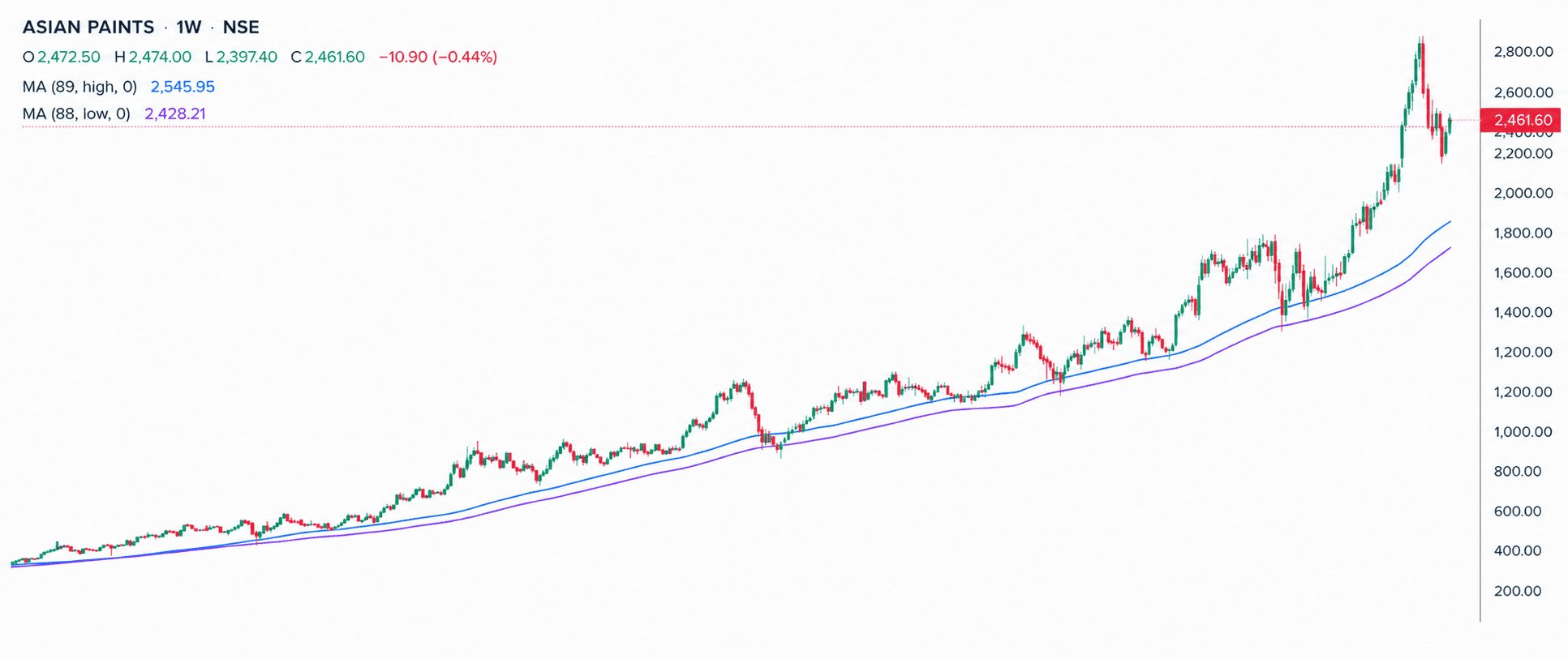
ASIAN PAINTS WEEKLY CHART
Targets: Long-Term Gains
This strategy is not for day trading or short-term swings. You’ll hold positions for months, or even years.
Minimum Target: 1:10 Reward-to-Risk
This means if you risk ₹10, you aim for at least ₹100 in profit.
Historically, trend-following systems on stocks like Asian Paints can yield much higher ratios—1:20, 1:30, or even 1:50—if you allow your winning trades to run for extended periods.
The timeframe for this strategy is always weekly.
Why the Weekly Timeframe Matters
Using only the weekly chart offers several advantages:
- It helps you spot and ride major trends.
- You get fewer false signals compared to shorter timeframes.
- It aligns with the behavior of long-term investors.
- It reduces the emotional reactions that often come with watching daily price swings.
- It cuts through daily market noise.
No daily charts. No intraday distractions. Just a focus on weekly price structure and the patience to let a trend unfold.
A Simple Example
Imagine Asian Paints’ price drops and touches the 88-Low MA zone.
Then, a bullish hammer candle forms on the weekly chart.
The following week, the price breaks above the high of that hammer candle—this is your buy signal.
You place your stop-loss just below the hammer's low.
Weeks turn into months, and the stock steadily climbs. This becomes a significant compounding move, quietly generating wealth over time.
Why This Strategy Is Effective
This system works well because it combines several powerful elements:
- Trend: Defined by the moving averages.
- Support: Identified by the 88-Low MA.
- Confirmation: Provided by bullish candle patterns.
- Momentum: Confirmed by entering above the prior candle's high.
- Long-Term Compounding: Enabled by the weekly chart and extended holding periods.
It keeps you aligned with the bigger market players—the institutions and funds that drive long-term trends.
We've observed approximately 20 to 22 trading setups with this system so far, with only 2 to 3 stop-outs. This suggests a high accuracy rate in historical data.
Currently, Asian Paints is consolidating. There isn't an active entry or trade setup right now. It's best to wait for the moving averages to begin rising and then look for these specific entry patterns.
Who Benefits from This Strategy?
This method is ideal for:
- Long-term investors
- Busy professionals
- Part-time traders
- Anyone preferring slow, steady compounding
- Those who want simple, "set-and-forget" rules
Last Thoughts
The Asian Paints 89-High & 88-Low MA Strategy offers:
- Clear, objective rules
- Low-stress trading
- Very high potential for reward
- Independence from intraday volatility
- A path to long-term wealth building
It’s simple enough for new investors but robust enough for experienced long-term players. Remember:
This content is for educational purposes only, not financial advice. All markets involve risk. Always conduct your own research and consult a qualified financial advisor before making investment decisions.