
If you've ever watched a stock jump the moment a headline breaks, you already believe in the connection between news and price. The real question professional traders have been chasing for decades is: can a machine actually use that connection to make money — reliably, and at scale?
A new approach to algorithmic trading suggests the answer is yes, but with an important twist: it's not just about feeding an AI both news sentiment and price charts. It's about how you combine them.
Two Very Different Ways of Reading the Market
Before diving into the twist, it helps to understand the two ingredients being combined.
Technical analysis is the classic approach — looking at price charts, moving averages, momentum, and volatility to spot patterns. It's the "the chart tells the story" school of trading, and it's been the backbone of algorithmic trading for years.
Sentiment analysis is newer and messier — it means scanning news articles, headlines, and summaries about a company and scoring whether the coverage is positive, negative, or neutral. Instead of asking "what did the price do," it asks "what is everyone saying right now, and does that mood predict what the price will do next."
Individually, both approaches have shown they can generate real trading edge. The obvious next question: what happens if you use both at once?
The Problem With Just Throwing Everything Together
Here's the surprising part. When researchers tested a model that simply mixed technical and sentiment signals together — letting an AI freely combine whichever indicators it wanted — the results were underwhelming. The mixed model actually underperformed a version that kept the two signal types completely separate.
Think of it like a hiring committee where one loud voice dominates every discussion. If technical indicators and sentiment indicators are thrown into the same pot, one type tends to drown out the other during the model's learning process, and you don't get the "best of both worlds" you were hoping for.
The Fix: Give Each Signal Type Its Own Lane
The more effective design forces a kind of structural discipline. The trading model is built as a decision tree with two separate branches — one branch is only allowed to use sentiment signals, the other is only allowed to use technical signals. The two branches meet at the top through a simple rule: buy only if both branches agree there's an opportunity.
This "each signal type gets its own space, then they vote together" structure turns out to matter enormously. It forces the model to genuinely weigh both types of evidence rather than letting one dominate, and the result is a more balanced, more adaptable trading strategy.
To build sentiment signals worth including, the model doesn't just slap a single "positive or negative" label on a stock. It runs three different, well-established sentiment-scoring tools (TextBlob, SentiWordNet, and AFINN) across a company's news — analyzing the headline, the summary, and the full article body separately. That produces a dozen distinct sentiment readings per article, giving the model a much richer picture of market mood than a single sentiment score ever could. On the price side, it draws from six well-known technical indicators (things like moving averages, momentum, and volatility) calculated over both short and slightly longer lookback windows.
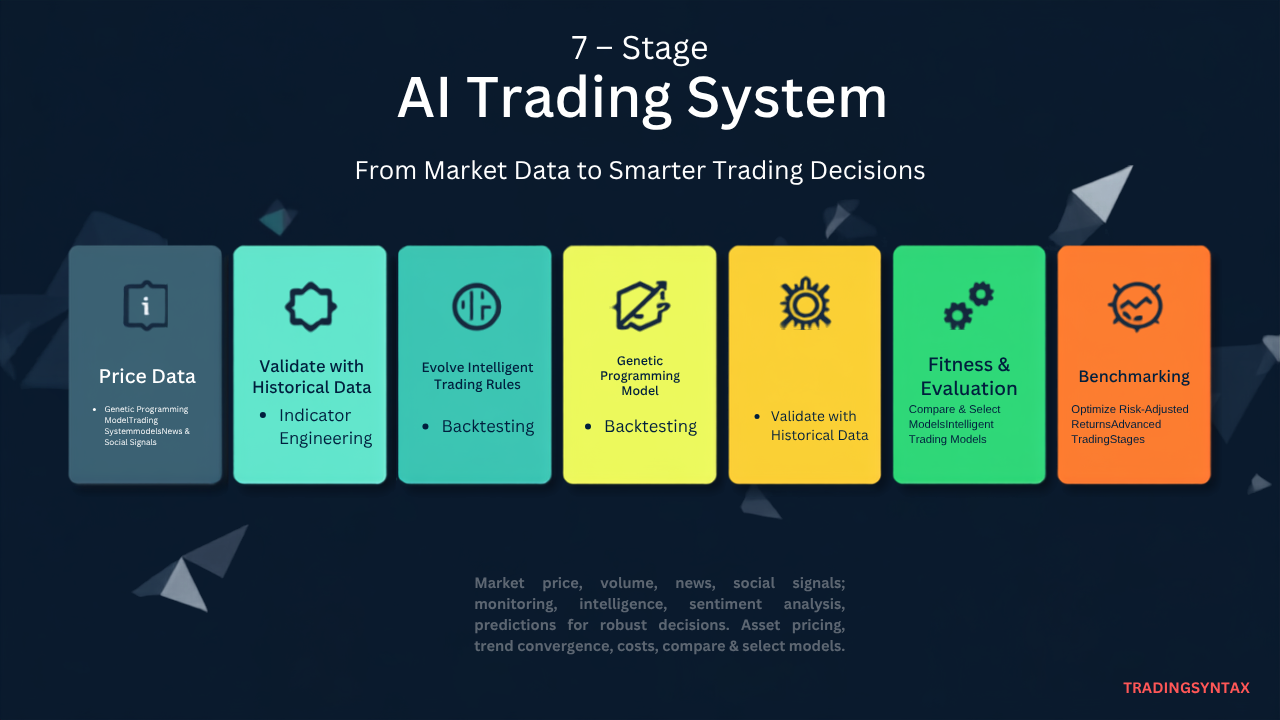
Ai Trading System Workflow
So Does It Actually Work?
The structured approach was tested against 60 real companies spanning tech, fashion, food, automotive, finance, and media — including household names like Apple, Amazon, Tesla, Nike, and Coca-Cola — using five years of historical price and news data.
The results were striking:
- It beat a "mix everything together" approach by a wide margin on risk-adjusted returns, confirming that structure — not just access to more data — is what unlocks the real advantage.
- It beat using either signal type alone. Price-only models and news-only models both underperformed the combined, structured approach.
- It beat traditional machine learning models — including neural networks and gradient-boosted trees — by a wide margin, while taking on noticeably less risk.
- It beat simple buy-and-hold investing, generating meaningfully higher cumulative returns over the same period.
- It traded far less often than a comparable rules-based strategy (roughly 10 trades vs. 230) while still producing better outcomes across the board — a sign it was learning to identify genuinely strong opportunities rather than trading on autopilot.
- It held up in both rising and falling markets, performing especially well during strong uptrends and strong downtrends — arguably the hardest test for any trading strategy, since many models only shine in one type of market.
Why This Matters Beyond the Numbers
The bigger takeaway isn't just "combining news and price data works." It's that the architecture of how you combine multiple data sources matters as much as the data itself. A lot of AI trading tools (and frankly, a lot of AI tools in general) assume that more data thrown into one big model automatically means better results. This shows that's not always true — sometimes forcing structure and separation into a model produces smarter behavior than letting it figure everything out on its own.
For anyone building or evaluating an AI-driven trading tool, sentiment tracker, or market-monitoring dashboard, this is a useful principle to borrow: don't just aggregate signals, think carefully about how they should interact.
What's Next for Sentiment-Driven Trading Models
The next frontier for this kind of approach likely includes swapping in more advanced language models (like BERT-based sentiment tools) for even richer news understanding, pulling in a wider range of sources like financial forums and opinion columns, and eventually blending in fundamental company data — earnings, balance sheets, and the like — as a third pillar alongside price and sentiment.
As markets and the language used to describe them keep evolving, the tools built to read both will need to keep evolving too.
Markets evolve. Language evolves. Your sentiment model must evolve too.